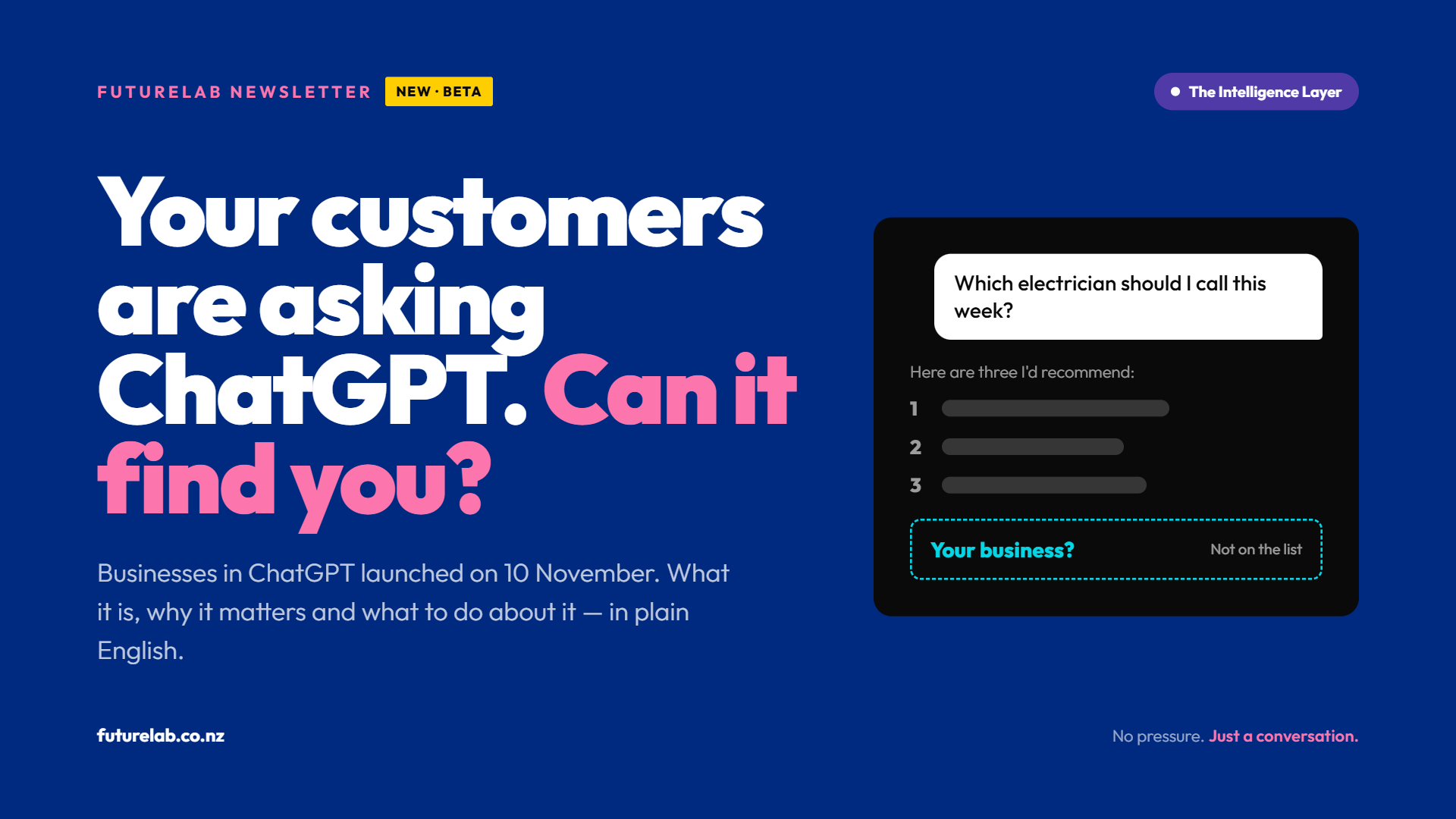
Your Customers Are Asking ChatGPT. Can It Find You?
On 10 November 2026, OpenAI, the company behind ChatGPT, started letting businesses sign up and tell ChatGPT who they are. It’s called Businesses in ChatGPT, and it’s in beta, which means early testing.
What is it, in plain English?
It’s a way to hand ChatGPT your business card: what you do, where you are, what you sell and what it costs. That way, it stops guessing.
Think of ChatGPT as the world’s busiest travel agent
Think about what you do when you land in a country you don’t know. You ask a tour guide or a travel agent where to eat or who to trust, and you usually go with what they say. Nowadays, people do that with ChatGPT for everything: which accountant to call, where to buy running shoes, who can fix a leaking roof. And like any guide, it recommends based on what it knows.
Here’s the catch, if ChatGPT can’t find you, it recommends someone it can. That customer doesn’t call you or visit your website, it just goes to you competitor.
What it actually is?
There are three parts:
- Business Hub. You claim your business, update your details, and, once verified, add product feeds with current pricing and availability.
- Insights. You can see how often your business is mentioned, how many people click through to your website, and the topics that come up in conversations that cite you.
- Business Agent. Eligible businesses can build a branded assistant inside ChatGPT that answers customer questions about what they offer. Those conversations are labelled, and OpenAI says it doesn’t share people’s chats with businesses.
Why it matters?
Plenty of business owners tell us AI has nothing to do with them. They don’t use it, their customers “aren’t really online like that”, and their website is fine.
It doesn’t matter whether you use AI. Your potential customers do. Right now, someone is asking ChatGPT “which electrician should I call?”, “what’s the best accountant for a small business?” or “where can I get this fixed?” They get a short list of names, and most of them simply go with it, just as you would with the travel agent’s pick.
If the AI can’t see you clearly, because your details are out of date, your website doesn’t explain what you do, or you’re simply not there, it recommends someone it can see. You’ll never know it happened. That’s the real shift. It isn’t about adopting a new gadget. It’s about whether the AI can describe your business at all.
A quick honest note
It’s early. It isn’t open to every business in every country yet, and signing up doesn’t guarantee ChatGPT will recommend you. OpenAI says claiming your business shouldn’t change how often you appear, so it isn’t a magic ranking button. What it does is make sure that when ChatGPT does talk about you, it has the right information. Whether you get mentioned at all still depends on having a website that clearly says what you do, which is a good reason to treat your site as an asset and not a once-a-year job.
What we’re doing about it
We’re already working through this with the clients we do SEO for.
You can book a 30-minute call with our developer and we’ll set it up together. There’s a quick technical step on your website, so it’s much easier when we do it with you. It’s a new feature, which means the businesses that set it up early get a say in what ChatGPT tells people about them from day one.
Because a change like this only comes along rarely, we’d rather be early and careful than late.
If we’re not already looking after your SEO and you’d like us to run through this with you, just get in touch. We’ll talk to you about the details
Sources
OpenAI. (2026, November 10). Introducing Businesses in ChatGPT (beta). OpenAI Developer Community. https://community.openai.com/t/introducing-businesses-in-chatgpt-in-beta/1414865
Relevant Audience. (2026). Businesses in ChatGPT: Business Hub, Insights and Agents. https://www.relevantaudience.com/geo/openai-businesses-in-chatgpt-business-hub-business-agents/
